A two-vehicle crash can already create disagreements about speed, right of way, and fault. When three or more vehicles are involved, determining responsibility becomes significantly more complicated. One driver’s mistake may trigger the initial impact, another may contribute to a second collision, and several insurers may disagree about how much responsibility belongs to each.
For someone injured in a multi-vehicle car accident in Beverly Hills, this makes the claims process confusing. The driver who struck your vehicle may not be the only person whose negligence contributed to your injuries, and the first collision may not be the one that caused the most serious harm. California law divides responsibility among everyone who contributed, but determining those percentages requires reconstructing the sequence of collisions and each driver’s role in it.
Multi-Vehicle Accidents Begin with One Event but Develop in Seconds
Many multi-vehicle collisions begin with a single mistake. A driver follows too closely, makes an unsafe lane change, or fails to notice that traffic ahead has stopped, and the first impact pushes one vehicle into another or causes surrounding drivers to swerve, brake, or collide with additional vehicles.
In other situations, several drivers make separate mistakes almost simultaneously: one stops abruptly, another follows too closely, and a third is traveling too fast to avoid the developing crash. Although the impacts occur within seconds, each driver’s conduct is evaluated separately. Calling a crash a pileup does not explain who is responsible; the analysis begins with reconstructing what happened before, during, and after the first impact.
California Comparative Fault Divides Responsibility Among Every Contributing Driver
California uses comparative fault principles when more than one person’s negligence contributes to an injury. Instead of making one driver completely responsible or completely free of fault, responsibility is divided among everyone whose conduct contributed, including the injured person if their own conduct played a role. An injured person can still pursue compensation while partially responsible, with the amount reduced by their percentage of fault.
An initial negligent act does not excuse everyone who becomes involved afterward. Suppose a driver suddenly changes lanes and causes traffic to brake, a second driver following too closely collides with the vehicle ahead, and a distracted third driver crashes into the developing accident. The lane change started the sequence, but more than one cause can contribute to the same injury, and a driver cannot avoid responsibility because someone else’s negligence also helped cause the crash. Insurers push responsibility toward whichever driver appears to have started the chain, and fault percentages become the most contested part of a multi-vehicle claim because each insurer wants to minimize its own insured’s share.
Chain-Reaction Collisions Require Careful Reconstruction of Each Impact
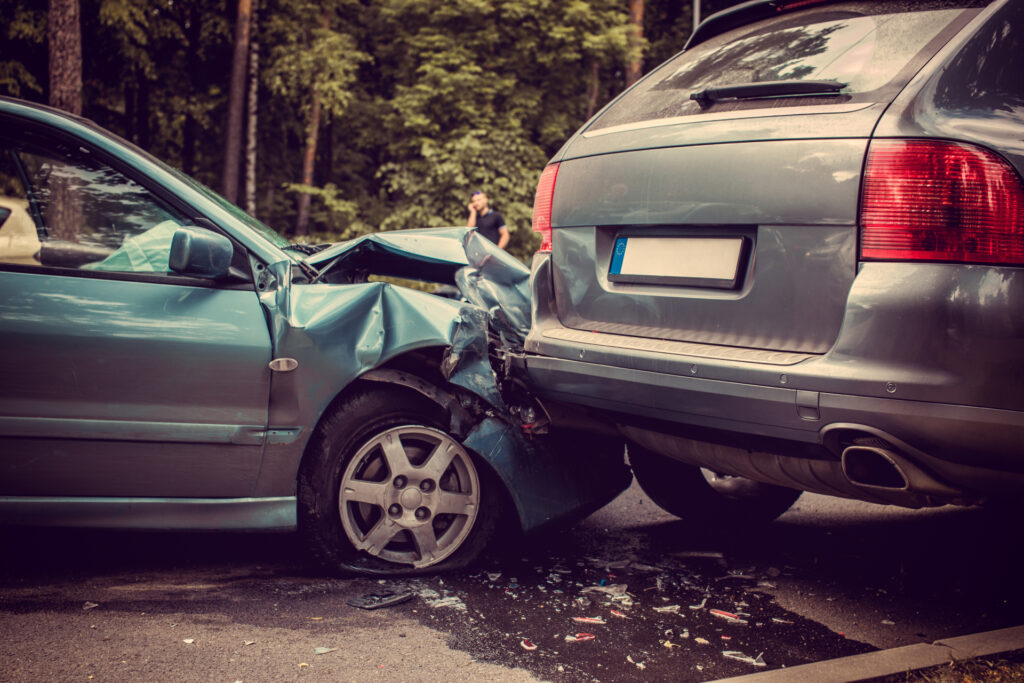
Chain-reaction accidents are the most common multi-vehicle crash, typically occurring in congested traffic when one vehicle strikes another from behind and pushes it into additional vehicles. Determining responsibility requires establishing whether each impact resulted from the initial collision or whether separate drivers independently caused later impacts. A driver who was stopped and pushed into another vehicle is in a very different position from one who struck the vehicle ahead before being hit from behind.
Drivers and passengers often remember the number and timing of impacts differently, and many assume the vehicle directly behind them caused every jolt. The order of impacts also matters for medical causation. Imagine a driver struck from behind and pushed into another vehicle. The first insurer argues the second impact caused the injury, while the second insurer claims the damage was already done. Medical records, the timing of symptoms, and the forces involved in each impact become relevant, and the more significant the injuries, the more closely insurers examine causation.
Evidence Resolves Conflicting Accounts, and It Must Be Preserved Early
Multi-vehicle accidents produce conflicting accounts, since each driver sees the collision from a different position. Physical evidence fills those gaps; damage patterns indicate the direction and force of impacts, and photographs document vehicle positions and skid marks. Dashcam footage is particularly valuable because it may capture the events leading up to the first collision rather than only the aftermath, and surveillance video from nearby businesses may show the order in which vehicles collided. Witness statements provide an independent perspective, and in serious crashes, reconstruction specialists may analyze electronic vehicle data and damage to determine how the collision occurred.
The earlier this information is preserved, the better. Insurers begin investigating almost immediately, and each carrier develops a position on fault from its own driver’s account and the police report. Those conclusions are not necessarily correct, and video is overwritten, vehicles repaired, and witnesses lost as time passes.
Multiple Insurance Companies and Limited Policy Coverage Complicate the Claim
A multi-vehicle accident may involve several insurance companies, each conducting their own investigation and reaching a different conclusion. One insurer argues that another driver caused the initial collision, a second accepts some responsibility while claiming another vehicle contributed more, and a third disputes whether its driver was negligent at all. The injured person may receive requests from several carriers rather than one adjuster, and these competing positions create delays.
Policy limits add another layer. When several people are seriously injured in the same crash, multiple claimants may be seeking compensation from the same policy, and the coverage may not go around. Identifying every responsible party and every source of insurance, including the injured person’s own underinsured motorist coverage, is therefore essential.
Economic and Noneconomic Damages Are Allocated Differently Among Defendants
When several defendants are responsible for the same injury, California law treats two categories of damages differently. Economic damages are measurable financial losses such as medical expenses, lost earnings, and future care. Noneconomic damages address harms without an invoice, such as pain, suffering, and loss of enjoyment of life.
Under California Civil Code Section 1431.2, each responsible defendant can be held liable for the injured person’s full economic damages, regardless of that defendant’s percentage of fault, but only for its own share of noneconomic damages. In practical terms, if one at-fault driver is uninsured, the injured person may still recover the full economic loss from another responsible driver, but the noneconomic share attributable to the uninsured driver may be difficult to collect. This is one reason identifying every party responsible matters so much.
A Beverly Hills car accident attorney can examine the entire sequence, identify every responsible driver, preserve evidence, and communicate with multiple insurers at once. This matters most when one insurer is trying to place responsibility on another driver, or when the injured person is being assigned a percentage of fault the evidence does not support. The objective is not simply to determine which vehicle made first contact; it is to understand how every party’s actions contributed to the accident and the resulting injuries, including traumatic brain injuries and spinal injuries.
Frequently Asked Questions About Multi-Vehicle Car Accidents
Can I recover from a driver whose vehicle never hit mine?
Potentially, yes. If that driver’s negligence set the chain of events in motion or contributed to the collision that injured you, they may share responsibility even though their vehicle never touched yours. Fault follows causation.
Who is responsible in a chain-reaction rear-end accident?
It depends on the sequence. One driver may have caused the initial collision and pushed other vehicles together, or several drivers may have independently contributed by following too closely or speeding. Reconstructing the order of impacts comes first.
What happens if the at-fault drivers do not have enough insurance to cover everyone injured?
Each at-fault driver’s insurer may be responsible for a share, and when several people are seriously injured, those policies can be exhausted. Your own underinsured motorist coverage, if you carry it, may fill part of the gap, which is why identifying every applicable policy early matters.
How does California divide damages when several drivers are at fault?
Each responsible driver can be held liable for your full economic damages, such as medical bills and lost wages, regardless of their fault percentage, but only for their own share of noneconomic damages like pain and suffering. The practical effect depends on which drivers are insured.
Can I still pursue a claim if my injuries were caused by a second or third impact?
Yes, though it is more complicated. Each insurer may argue that a different impact caused your injury, so medical causation is disputed alongside fault. Thorough documentation of your treatment and the sequence of impacts is especially important.
Getting Clarity After a Multi-Vehicle Accident in Beverly Hills
Multi-vehicle accidents are complicated because liability rarely depends on a single point of impact. Investigators must determine who started the sequence, whether other drivers contributed, and which collision caused particular injuries, and comparative fault divides responsibility according to the evidence rather than forcing every crash into an all or nothing conclusion.
At Titan Law Firm, our Beverly Hills personal injury team carefully investigates serious car accidents involving multiple vehicles and competing insurance companies. Led by Justin Bina, we help clients understand how fault may be allocated, identify the parties and policies involved, and evaluate the full impact of their injuries.
If you or a family member was injured in a multi-vehicle car accident in Beverly Hills or the surrounding Los Angeles area, early guidance can help preserve important evidence and clarify your options. Contact Titan Law Firm to schedule a free consultation and discuss the circumstances surrounding your accident.
Call us at (888) 848-2656 or visit www.TitanLawFirm.com to learn more.